
Sixty Seconds Would Have Been Enough

Vintage Lemania stopwatch displaying seconds, minutes, and 1/10-second scales

The Home Ministry has decided that all six stanzas of Vande Mataram, the full official version, which runs three minutes and ten seconds, must now be rendered at government functions, flag ceremonies, and civil investitures, and that it must come before Jana Gana Mana. Schools have been “urged” to sing it at morning assembly, which in Indian administrative language means they will.

Read that directive, and you can practically see the room it was written in. Wood panelling. A long table. Not one person under fifty-five. This is a decision made by people whose diaries have gaps in them, for people whose diaries do not. Let me be blunt about the arithmetic, because nobody in that room did it. The national anthem takes fifty-two seconds. The new national song takes one hundred and ninety seconds. We have just quadrupled the ceremonial standing time at every official event in the country. Multiply that by every school assembly, every college convocation, every departmental function, every parade – across 1.4 billion people – and you are looking at one of the largest voluntary donations of national productivity in recent memory. For a country that constantly talks about the demographic dividend and doing more with less, we have found a remarkable way to do less with more.

And here is the part the committee genuinely does not understand: young India is not moved by it. Not because they lack patriotism – that charge is lazy and wrong – but because a slow, solemn, Sanskritised dirge is not how this generation feels anything. They feel things in ninety-second reels, in stadium chants, in a beat that lifts the chest. Ask any twenty-year-old standing in the fourth row of an assembly what they were thinking during stanza five. They were thinking about breakfast.

So here is the alternative, and it is not a rejection of the song – it is a rescue of it.

Commission a new official rendition. Keep the words sacred, change everything else. Make it fast. Make it big. Percussion that starts on the first beat. A tempo you march to, not a tempo you endure. Voices that build rather than drone. And cap it at sixty seconds – one minute, no exceptions, no ceremonial drumroll of seven slow marching paces to warm us up first.

A.R. Rahman proved this in 1997. Maa Tujhe Salaam did more for the emotional life of that phrase in six minutes of radio play than fifty years of harmonium have managed. We know how to do this. We simply did not ask the people who know how.

Reverence is not measured in minutes. A song that thrills you in sixty seconds will be sung willingly for a century. A song that bores you for one hundred and ninety will be endured, resented, and quietly mouthed.

We had a chance to make the national song feel national again. Instead, we made it longer.

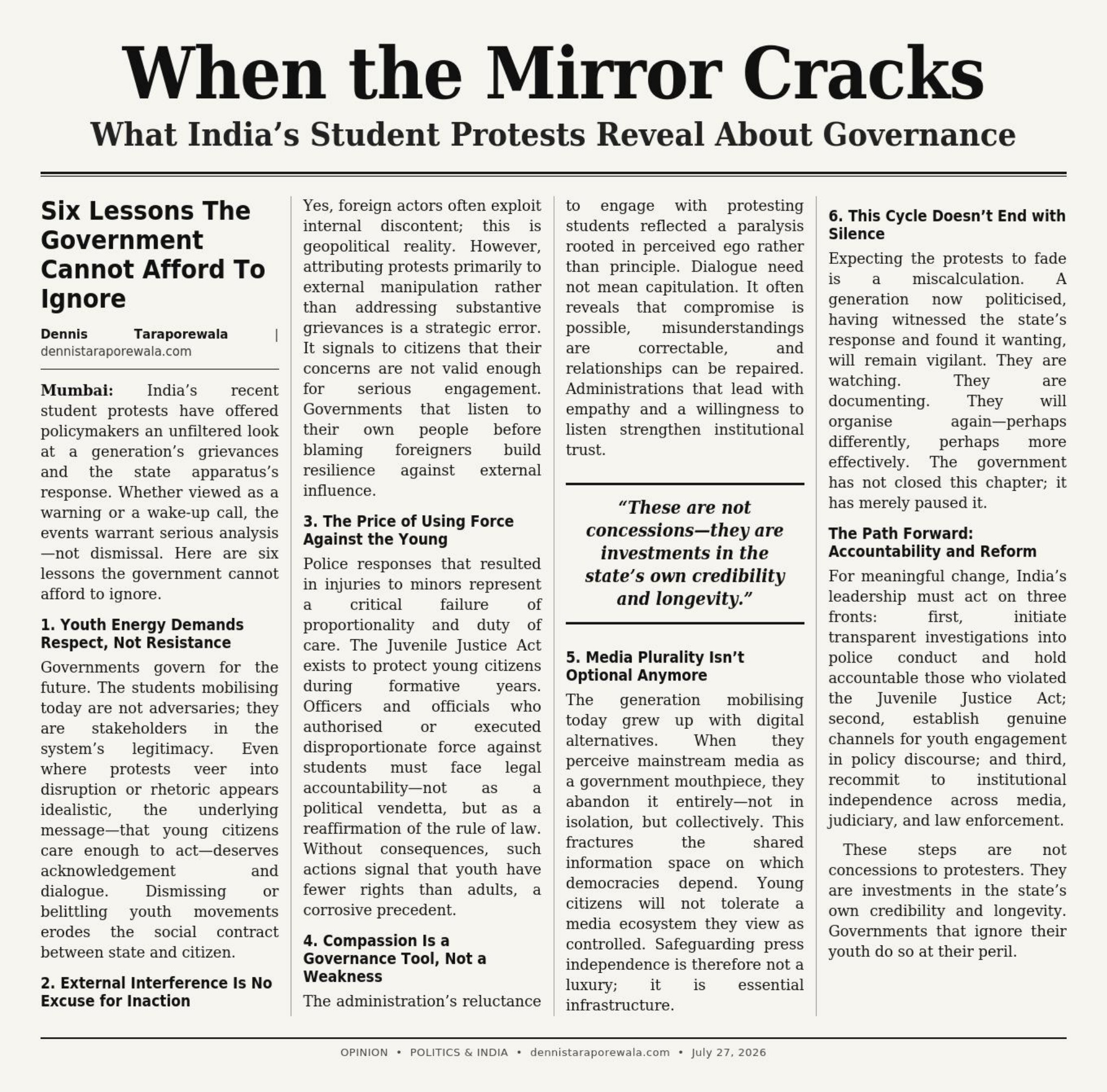
When the Mirror Cracks: What India’s Student Protests Reveal About Governance

India’s recent student protests have offered policymakers an unfiltered look at a generation’s grievances and the state apparatus’s response. Whether viewed as a warning or a wake-up call, the events warrant serious analysis—not dismissal. Here are six lessons the government cannot afford to ignore.

1. Youth Energy Demands Respect, Not Resistance

Governments govern for the future. The students mobilising today are not adversaries; they are stakeholders in the system’s legitimacy. Even where protests veer into disruption or rhetoric appears idealistic, the underlying message—that young citizens care enough to act—deserves acknowledgement and dialogue. Dismissing or belittling youth movements erodes the social contract between state and citizen.

2. External Interference Is No Excuse for Inaction

Yes, foreign actors often exploit internal discontent; this is geopolitical reality. However, attributing protests primarily to external manipulation rather than addressing substantive grievances is a strategic error. It signals to citizens that their concerns are not valid enough for serious engagement. Governments that listen to their own people before blaming foreigners build resilience against external influence.

3. The Price of Using Force Against the Young

Police responses that resulted in injuries to minors represent a critical failure of proportionality and duty of care. The Juvenile Justice Act exists to protect young citizens during formative years. Officers and officials who authorised or executed disproportionate force against students must face legal accountability—not as a political vendetta, but as a reaffirmation of the rule of law. Without consequences, such actions signal that youth have fewer rights than adults, a corrosive precedent.

4. Compassion Is a Governance Tool, Not a Weakness

The administration’s reluctance to engage with protesting students reflected a paralysis rooted in perceived ego rather than principle. Dialogue need not mean capitulation. It often reveals that compromise is possible, misunderstandings are correctable, and relationships can be repaired. Administrations that lead with empathy and a willingness to listen strengthen institutional trust.

5. Media Plurality Isn’t Optional Anymore

The generation mobilising today grew up with digital alternatives. When they perceive mainstream media as a government mouthpiece, they abandon it entirely—not in isolation, but collectively. This fractures the shared information space on which democracies depend. Young citizens will not tolerate a media ecosystem they view as controlled. Safeguarding press independence is therefore not a luxury; it is essential infrastructure.

6. This Cycle Doesn’t End with Silence

Expecting the protests to fade is a miscalculation. A generation now politicised, having witnessed the state’s response and found it wanting, will remain vigilant. They are watching. They are documenting. They will organise again—perhaps differently, perhaps more effectively. The government has not closed this chapter; it has merely paused it.

The Path Forward: Accountability and Reform

For meaningful change, India’s leadership must act on three fronts: first, initiate transparent investigations into police conduct and hold accountable those who violated the Juvenile Justice Act; second, establish genuine channels for youth engagement in policy discourse; and third, recommit to institutional independence across media, judiciary, and law enforcement.

These steps are not concessions to protesters. They are investments in the state’s own credibility and longevity. Governments that ignore their youth do so at their peril.

When The Mirror Cracks

Being Productive Through Trying Times: 4 strategies to keep working

We all face challenges and difficulties in our lives, whether it’s personal, professional, or global. Sometimes, these hardships can make us feel overwhelmed, stressed, or demotivated. How can we maintain our productivity and performance when things get tough? Here are four strategies that can help you cope and keep working through trying times.

Being productive

  1. Acknowledge your emotions and seek support. It’s normal and healthy to have emotional reactions to stressful situations. Don’t ignore or suppress your feelings, but rather acknowledge them and express them in constructive ways. For example, you can talk to a trusted friend, family member, or colleague, write in a journal, or seek professional help if needed. Sharing your emotions can help you feel less alone and more understood.
  2. Focus on what you can control and let go of what you can’t. When facing hardships, it’s easy to feel powerless and hopeless. However, you can regain a sense of agency and optimism by focusing on the aspects of your situation that you can influence and change, and letting go of the ones that you can’t. For example, you can’t control the outcome of a global pandemic, but you can control how you protect yourself and others by following health guidelines. You can also control how you spend your time and energy, and what goals you set for yourself.
  3. Prioritize your tasks and set realistic expectations. When you have a lot on your plate, it can be hard to decide what to do first and how to manage your time. To avoid feeling overwhelmed and burned out, it’s important to prioritize your tasks according to their urgency and importance, and set realistic expectations for yourself and others. For example, you can use a matrix or a list to rank your tasks from high to low priority, and then focus on the most critical ones first. You can also break down larger projects into smaller and more manageable steps, and set specific deadlines for each one. Don’t forget to celebrate your progress and achievements along the way.
  4. Take care of yourself and practice self-compassion. Being productive doesn’t mean neglecting your physical, mental, and emotional well-being. In fact, taking care of yourself is essential for maintaining your energy, motivation, and resilience. Make sure you get enough sleep, eat well, exercise regularly, and engage in activities that bring you joy and relaxation. Also, practice self-compassion by being kind and supportive to yourself, especially when you make mistakes or face setbacks. Remember that you are not alone in your struggles, and that you are doing the best you can with what you have.