
Sixty Seconds Would Have Been Enough

Vintage Lemania stopwatch displaying seconds, minutes, and 1/10-second scales

The Home Ministry has decided that all six stanzas of Vande Mataram, the full official version, which runs three minutes and ten seconds, must now be rendered at government functions, flag ceremonies, and civil investitures, and that it must come before Jana Gana Mana. Schools have been “urged” to sing it at morning assembly, which in Indian administrative language means they will.

Read that directive, and you can practically see the room it was written in. Wood panelling. A long table. Not one person under fifty-five. This is a decision made by people whose diaries have gaps in them, for people whose diaries do not. Let me be blunt about the arithmetic, because nobody in that room did it. The national anthem takes fifty-two seconds. The new national song takes one hundred and ninety seconds. We have just quadrupled the ceremonial standing time at every official event in the country. Multiply that by every school assembly, every college convocation, every departmental function, every parade – across 1.4 billion people – and you are looking at one of the largest voluntary donations of national productivity in recent memory. For a country that constantly talks about the demographic dividend and doing more with less, we have found a remarkable way to do less with more.

And here is the part the committee genuinely does not understand: young India is not moved by it. Not because they lack patriotism – that charge is lazy and wrong – but because a slow, solemn, Sanskritised dirge is not how this generation feels anything. They feel things in ninety-second reels, in stadium chants, in a beat that lifts the chest. Ask any twenty-year-old standing in the fourth row of an assembly what they were thinking during stanza five. They were thinking about breakfast.

So here is the alternative, and it is not a rejection of the song – it is a rescue of it.

Commission a new official rendition. Keep the words sacred, change everything else. Make it fast. Make it big. Percussion that starts on the first beat. A tempo you march to, not a tempo you endure. Voices that build rather than drone. And cap it at sixty seconds – one minute, no exceptions, no ceremonial drumroll of seven slow marching paces to warm us up first.

A.R. Rahman proved this in 1997. Maa Tujhe Salaam did more for the emotional life of that phrase in six minutes of radio play than fifty years of harmonium have managed. We know how to do this. We simply did not ask the people who know how.

Reverence is not measured in minutes. A song that thrills you in sixty seconds will be sung willingly for a century. A song that bores you for one hundred and ninety will be endured, resented, and quietly mouthed.

We had a chance to make the national song feel national again. Instead, we made it longer.

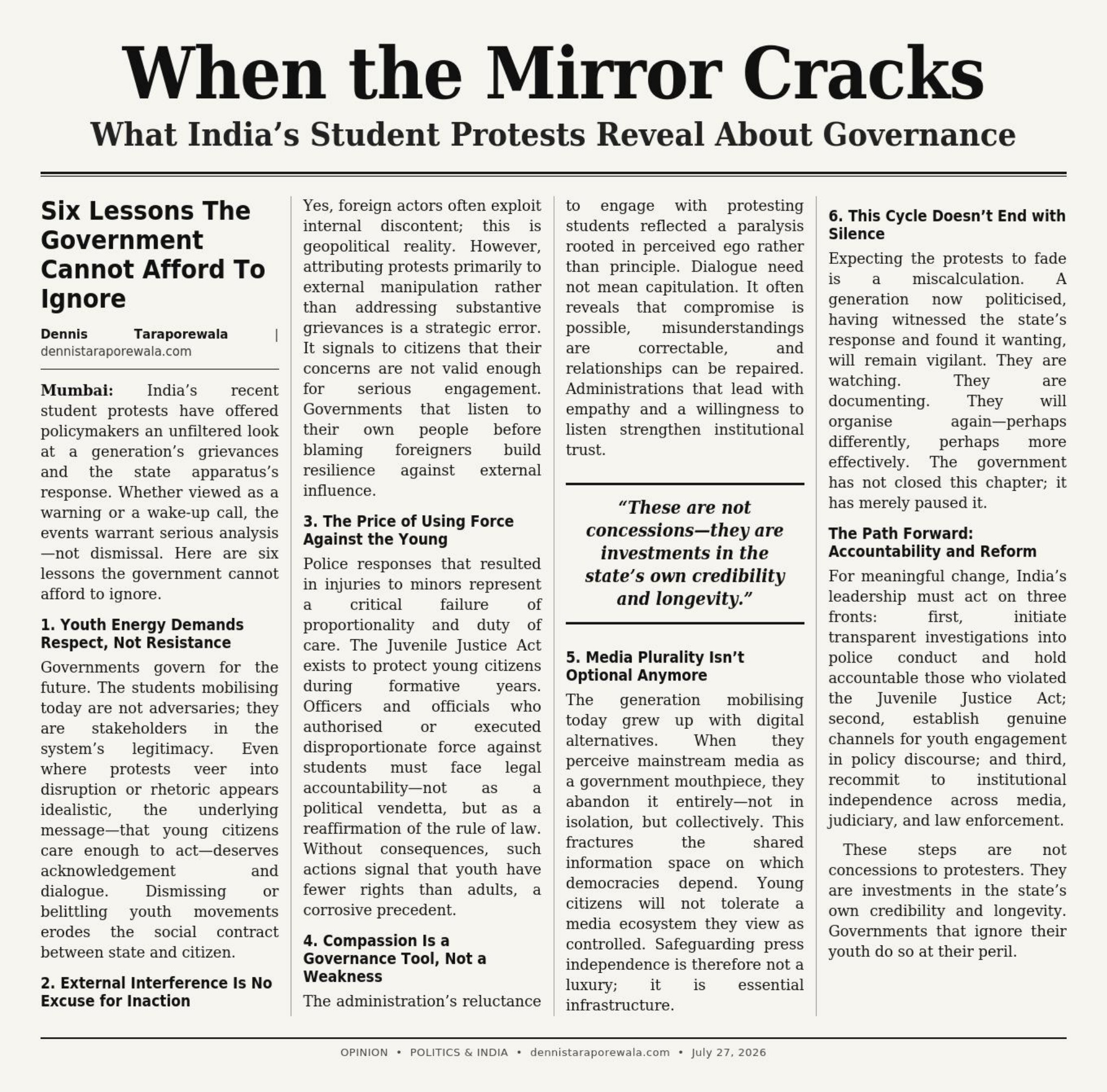
When the Mirror Cracks: What India’s Student Protests Reveal About Governance

India’s recent student protests have offered policymakers an unfiltered look at a generation’s grievances and the state apparatus’s response. Whether viewed as a warning or a wake-up call, the events warrant serious analysis—not dismissal. Here are six lessons the government cannot afford to ignore.

1. Youth Energy Demands Respect, Not Resistance

Governments govern for the future. The students mobilising today are not adversaries; they are stakeholders in the system’s legitimacy. Even where protests veer into disruption or rhetoric appears idealistic, the underlying message—that young citizens care enough to act—deserves acknowledgement and dialogue. Dismissing or belittling youth movements erodes the social contract between state and citizen.

2. External Interference Is No Excuse for Inaction

Yes, foreign actors often exploit internal discontent; this is geopolitical reality. However, attributing protests primarily to external manipulation rather than addressing substantive grievances is a strategic error. It signals to citizens that their concerns are not valid enough for serious engagement. Governments that listen to their own people before blaming foreigners build resilience against external influence.

3. The Price of Using Force Against the Young

Police responses that resulted in injuries to minors represent a critical failure of proportionality and duty of care. The Juvenile Justice Act exists to protect young citizens during formative years. Officers and officials who authorised or executed disproportionate force against students must face legal accountability—not as a political vendetta, but as a reaffirmation of the rule of law. Without consequences, such actions signal that youth have fewer rights than adults, a corrosive precedent.

4. Compassion Is a Governance Tool, Not a Weakness

The administration’s reluctance to engage with protesting students reflected a paralysis rooted in perceived ego rather than principle. Dialogue need not mean capitulation. It often reveals that compromise is possible, misunderstandings are correctable, and relationships can be repaired. Administrations that lead with empathy and a willingness to listen strengthen institutional trust.

5. Media Plurality Isn’t Optional Anymore

The generation mobilising today grew up with digital alternatives. When they perceive mainstream media as a government mouthpiece, they abandon it entirely—not in isolation, but collectively. This fractures the shared information space on which democracies depend. Young citizens will not tolerate a media ecosystem they view as controlled. Safeguarding press independence is therefore not a luxury; it is essential infrastructure.

6. This Cycle Doesn’t End with Silence

Expecting the protests to fade is a miscalculation. A generation now politicised, having witnessed the state’s response and found it wanting, will remain vigilant. They are watching. They are documenting. They will organise again—perhaps differently, perhaps more effectively. The government has not closed this chapter; it has merely paused it.

The Path Forward: Accountability and Reform

For meaningful change, India’s leadership must act on three fronts: first, initiate transparent investigations into police conduct and hold accountable those who violated the Juvenile Justice Act; second, establish genuine channels for youth engagement in policy discourse; and third, recommit to institutional independence across media, judiciary, and law enforcement.

These steps are not concessions to protesters. They are investments in the state’s own credibility and longevity. Governments that ignore their youth do so at their peril.

When The Mirror Cracks

Energy Speaks Louder: On Being Genuinely Happy for Another

Blessings of Lord Shiva

We have all felt it. You share good news – a milestone, a windfall, a moment of recognition – and someone says, “That’s wonderful, I’m so happy for you.” The words are correct. The smile is in place. And yet something in you registers a flatness, a subtle withholding. The sentence arrived, but the person didn’t.

Because here is the truth we rarely say aloud: most people cannot be genuinely happy for you. Not because they are bad people, but because genuine happiness for another is not a social skill. It is a spiritual attainment.

Words can be manufactured in an instant. Energy cannot. Energy is the unedited transcript of a person’s inner state, and it speaks louder than any congratulations. When someone is at war with themselves – comparing, measuring, quietly asking “why not me?” – your good news lands on them like a verdict. Their mouth says celebration; their field says contraction. And you feel it, even if you can’t name it.

The one who can rejoice in your joy is someone in deep communion with themselves. There is no vacancy in them for envy to occupy, because they are not experiencing themselves as separate from you in the first place. Your win does not subtract from their account because, in their understanding, there is only one account.

This is where the matter becomes sacred. The Vedic seers held that the same divinity dwells in every being – Ishvara sarva bhutanam, the Lord seated in the hearts of all. When you are genuinely happy for another, you are not performing generosity. You are recognising. You are seeing God in the other — and in that very instant, seeing God in yourself. The joy is not borrowed from them; it rises from the same source in you. This is why the authentic celebration of another person feels expansive rather than depleting. It is a moment of darshan – a glimpse of the divine wearing a different face.

So the next time congratulations feel hollow, don’t take it personally. The person is simply energetically telling you how far they are from their own centre. Offer them compassion; their struggle is not with you.

And the next time you feel a clean, unforced gladness at someone else’s good fortune – pause and notice it. That lightness is not politeness succeeding. It is communion. It is the Self recognising the Self, briefly forgetting the fiction of separation.

We spend so much effort trying to appear happy for others. The deeper work is to become the kind of person for whom it is effortless – someone so at home in themselves that another’s light only reminds them of their own. That is the quiet test of spiritual maturity: not how you handle your sorrows, but how you receive another’s joy.

Energy speaks louder. Make sure yours is saying something true.

Who Are We Really? A Nation Lost Between Pride and Reality

We often hear bold claims about India’s rising stature. There is the idea that we are on the path to becoming a “superpower.” It’s an attractive thought, one that feeds our pride. But let’s pause and ask: are we really there yet? The truth is sobering, and the time has come for some uncomfortable honesty.

Let’s start with the basics. Economically, we are not great. Yes, our GDP is climbing, and yes, India is a huge market. But size is not strength. Per capita income, wealth distribution, and job creation are crucial metrics. These metrics define true economic power. On these, we are still struggling. Compare this with countries like South Korea, which rebuilt itself after the war into a global technology hub within decades. We, on the other hand, are still battling unemployment and rural poverty on a massive scale.

Militarily, we have capacity, but to call ourselves a world power would be self-congratulation at best. True strength lies not just in weapons but in strategy, alliances, and global influence. The U.S. or China dictates global agendas. India, for all its growth, remains more of a participant than a shaper.

What about our civic achievements? Are our cities, villages, schools, hospitals, or governance models the envy of the world? Sadly, no. Internal civics remain one of our weakest points. Think about Bengaluru, our “Silicon Valley.” It powers the IT sector but struggles with crumbling infrastructure and water shortages. Or Delhi, the capital, is choking under pollution year after year with no effective long-term solution. Even Vietnam and Indonesia today have better cities, cleaner roads, and more functional pathways than we do. We, meanwhile, are creating substandard projects. And let’s be honest — no amount of building temples or mosques will make us a true, first-world, slick country. Our mindset of corrupt practices — the less said, the better.

Then comes the matter of innovation. Here our weaknesses glare the brightest. We boast of being an IT hub, but most of that is outsourced work, not homegrown breakthroughs. Where is the Indian equivalent of Apple, Tesla, or SpaceX? Even in cinema, Bollywood churns out volume, but how much of it sets global benchmarks in creativity? We are consumers of innovation, not creators. Without creativity, how do we lead the world?

Even when it comes to icons, our problem is the same. Take Ratan Tata. We love to praise him, put him on pedestals, and call him an “institution” in Indian business. But how many of us actually espouse the values he embodied — integrity, long-term vision, or job creation through enterprise? Almost no one. We pay lip service to leaders like him without absorbing their ethics or applying their discipline. We love the image, but avoid the hard work.

This is why the talk of India being a “superpower” in the next decade or two feels premature. At the current pace, it will take at least 50 years before we can realistically claim that word. To even dream of being a leader, we must first put our house in order. That means addressing corruption, mediocrity, and complacency at every level.

And before that, we must ask: who are we today? Often, we look back at our history. We think of the Mughals and the British. We remember centuries of invasions. We use that lens to define ourselves. Enough of that. Who cares who ruled us yesterday? The only thing that matters is who we are now.

And the truth is, today we are a mixed bag. Yes, there is brilliance — ISRO landing on the Moon, or entrepreneurs creating unicorns against all odds. But the nonsense far outweighs the good. Corruption, inefficiency, apathy — they are too widespread, too embedded in our systems.

If we want greatness, we must earn it. Not by chest-thumping or rewriting history, but by building a society where quality, creativity, and civic responsibility are non-negotiable. Only then will we truly deserve the title of “superpower.” And until then, let’s stop fooling ourselves. Right now, the world isn’t looking up at us. It’s shaking its head at us.