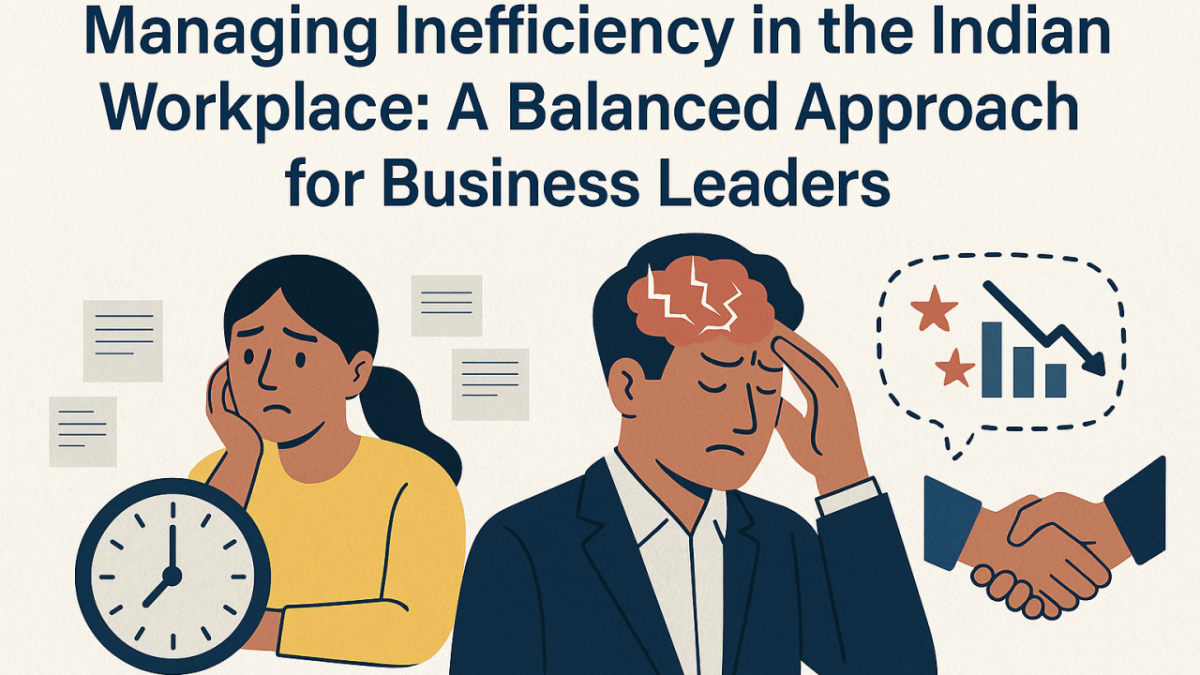
How Indian Leaders Tackle Inefficiency Challenges

Inefficiency is among the most pervasive challenges that Indian business leaders face across various sectors. While talent abounds, the execution gap is often frustratingly wide. Meetings are filled with enthusiastic promises, yet deadlines slip. Lunch breaks stretch longer than agreed, and follow-ups become the norm rather than the exception. So, how does a business leader manage this reality, not just operationally, but also emotionally?

1. Accept the Ground Reality, Then Build Systems

The first step is accepting that Indian work culture often operates at a slower rhythm. This isn’t a moral judgment—it’s a structural and cultural reality. Instead of resisting it, effective leaders build frameworks that assume some delay and create buffers for it. Micro-deadlines, checklists, and short daily stand-ups help keep momentum without relying on long, unproductive catch-ups.

2. Train for Execution, Not Eloquence

In India, there is often a large gap between what is said and what is done. Employees are trained to please with words, not outcomes. Business leaders must therefore shift the focus from articulation to action. Create a culture that rewards delivery over jargon. Publicly acknowledge those who execute silently and well — this subtle shift in value signals gets noticed.

3. Audit, Don’t Assume

Trust is good. Verification is better. Many projects fail because leaders assume work is being done as committed. Instituting a culture of gentle auditing, not micromanaging, helps bridge the trust-execution divide. Tools like shared dashboards or weekly deliverables can help track progress without causing friction.

4. Protect Your Mental Bandwidth

Leaders often end up personally carrying the emotional burden of inefficiency. The solution? Emotional detachment with clarity. Recognise that people will overpromise. They may not match your urgency or ownership. That’s not a reflection on you — it’s a professional reality. Instead of investing emotional energy into disappointment, create multiple fallback plans and focus on what can be done, not what should have been.

5. Build Around the Doers

Every organisation has a few who consistently deliver. Identify them. Empower them. Compensate them better. Sometimes, progress in India is not about moving the entire team at once but giving key individuals the space to push the engine forward while others slowly catch up.

Ultimately, managing inefficiency in India is part strategy, empathy, and mental discipline. The most effective leaders learn to work with the system, not against it.

Being Productive Through Trying Times: 4 strategies to keep working

We all face challenges and difficulties in our lives, whether it’s personal, professional, or global. Sometimes, these hardships can make us feel overwhelmed, stressed, or demotivated. How can we maintain our productivity and performance when things get tough? Here are four strategies that can help you cope and keep working through trying times.

Being productive

  1. Acknowledge your emotions and seek support. It’s normal and healthy to have emotional reactions to stressful situations. Don’t ignore or suppress your feelings, but rather acknowledge them and express them in constructive ways. For example, you can talk to a trusted friend, family member, or colleague, write in a journal, or seek professional help if needed. Sharing your emotions can help you feel less alone and more understood.
  2. Focus on what you can control and let go of what you can’t. When facing hardships, it’s easy to feel powerless and hopeless. However, you can regain a sense of agency and optimism by focusing on the aspects of your situation that you can influence and change, and letting go of the ones that you can’t. For example, you can’t control the outcome of a global pandemic, but you can control how you protect yourself and others by following health guidelines. You can also control how you spend your time and energy, and what goals you set for yourself.
  3. Prioritize your tasks and set realistic expectations. When you have a lot on your plate, it can be hard to decide what to do first and how to manage your time. To avoid feeling overwhelmed and burned out, it’s important to prioritize your tasks according to their urgency and importance, and set realistic expectations for yourself and others. For example, you can use a matrix or a list to rank your tasks from high to low priority, and then focus on the most critical ones first. You can also break down larger projects into smaller and more manageable steps, and set specific deadlines for each one. Don’t forget to celebrate your progress and achievements along the way.
  4. Take care of yourself and practice self-compassion. Being productive doesn’t mean neglecting your physical, mental, and emotional well-being. In fact, taking care of yourself is essential for maintaining your energy, motivation, and resilience. Make sure you get enough sleep, eat well, exercise regularly, and engage in activities that bring you joy and relaxation. Also, practice self-compassion by being kind and supportive to yourself, especially when you make mistakes or face setbacks. Remember that you are not alone in your struggles, and that you are doing the best you can with what you have.

The Psychology of Gambling: Understanding, Addressing, and Overcoming Problematic Behaviours

Gambling can have severe and multifaceted consequences. It negatively affects mental health, leading to stress, anxiety, depression, guilt, shame, and low self-esteem. It also impairs financial well-being,

Casinos are popular destinations for entertainment and socialization, offering excitement to many. However, it is essential to recognize that some individuals may develop problematic gambling behaviours, leading to adverse effects on their psychological well-being, finances, and relationships. In this article, I delve into the psychological factors motivating gambling, explore the consequences of excessive gambling, and provide strategies to prevent or alleviate gambling problems.

  1. The Illusion of Control: One significant psychological factor driving individuals to gamble is the illusion of control. This bias involves overestimating one’s ability to influence or predict the outcome of random events, such as rolling dice, drawing cards, or spinning slot machines. Those with a high illusion of control believe that their skills, strategies, or superstitions can enhance their chances of winning. They often attribute wins to their actions while blaming losses on external factors like bad luck. This cognitive bias reinforces gambling behaviour and hinders the acceptance of feedback or reality checks.
  2. The Gambler’s Fallacy: The gambler’s fallacy is another influential psychological factor shaping gambling behaviour. This fallacy revolves around the mistaken belief that past outcomes can affect future outcomes in a random process. For instance, a gambler may believe that after a long losing streak, they are due for a win, or vice versa. However, every outcome in gambling is independent and unaffected by previous results. Regardless of historical patterns, the probability of winning or losing remains the same.
  3. The Availability Heuristic: The availability heuristic also plays a role in gambling behaviour. This heuristic leads individuals to judge the frequency or likelihood of an event based on how easily examples come to mind. For example, a gambler may overestimate their chances of winning because they vividly remember their past wins or those of others while conveniently ignoring or forgetting their losses. This skewed perception of reality fosters unrealistic optimism regarding gambling outcomes.

The Negative Impact of Excessive Gambling:

Excessive gambling can have severe and multifaceted consequences. It negatively affects mental health, leading to stress, anxiety, depression, guilt, shame, and low self-esteem. It also impairs financial well-being, often resulting in debt, bankruptcy, poverty, and legal issues. Interpersonal relationships suffer due to conflicts, distrust, isolation, and increased divorce rates. Additionally, excessive gambling can interfere with work performance, education, and personal goals.

Strategies to Prevent or Reduce Gambling Problems:
Fortunately, several strategies can help prevent or reduce gambling problems:

  1. Setting Limits: Establishing and adhering to limits on time and money spent gambling is crucial. This approach fosters self-control and responsible behaviour.
  2. Seeking Support: Professional counsellors, support groups, and self-help programs offer valuable guidance and support for overcoming gambling addiction. These resources provide individuals with the necessary tools to regain control over their behaviour.
  3. Engaging in Alternative Activities: Finding alternative activities that provide positive reinforcement and satisfaction without involving gambling is essential. Hobbies, sports, volunteering, and socializing can fulfil individuals’ needs for enjoyment and social interaction while diverting their attention from gambling.

While gambling can be a source of entertainment for some, it can escalate into a severe problem for others. Understanding the psychological factors influencing gambling behaviour and recognizing the negative impacts of excessive gambling empowers individuals to make informed and responsible decisions about their gambling habits. Seeking help when needed and implementing preventive measures can help individuals address and overcome gambling problems, leading to improved psychological well-being, financial stability, and healthier relationships.

The Illusion of Separating Personal and Professional Life: Integrating for a More Fulfilling Experience

In this article, I argue that the separation between the personal and professional is simply a mental concept. Life is constructed by nature and is one continuum. We must weave together what we may consider personal and what we may consider work. Work is as much a part of our lives as our personal stuff is. And by integrating them, we can achieve more harmony, happiness, and fulfilment.

Many people struggle to balance their personal and professional lives. They feel stressed, overwhelmed, and guilty when they must juggle multiple roles and responsibilities. They think that they must separate their work from their life and that they have to sacrifice one for the other. But is this true? Is there such a thing as a clear-cut distinction between the personal and the professional? Or is this just a mental concept that we have created to cope with the complexity of modern life?

In this article, I argue that the separation between the personal and professional is simply a mental concept. Life is constructed by nature and is one continuum. We must weave together what we may consider personal and what we may consider work. Work is as much a part of our lives as our personal stuff is. And by integrating them, we can achieve more harmony, happiness, and fulfilment.

Photo by Kampus Production on Pexels.com

Let’s start by examining the origin of the idea of separating the personal and the professional. Historically, this idea emerged with the rise of industrialisation and urbanisation. People started to work in factories, offices, and other places that were physically separated from their homes and communities. They also started to specialise in different fields and professions that required specific skills and knowledge. As a result, they developed different identities and roles for their work and their life. They had to follow different rules, norms, and expectations in each domain. They had to switch between different modes of thinking, feeling, and behaving.

This separation was reinforced by the social and cultural values of modernity. Individualism, rationality, efficiency, productivity, competition, and achievement became the dominant ideals of work. Emotion, intuition, creativity, spirituality, cooperation, and well-being became the dominant ideals of life. Work was seen as a means to an end, a way to earn money and status. Life was seen as an end in itself, a way to enjoy leisure and happiness. Work was associated with stress and pressure. Life was associated with relaxation and pleasure.

However, this separation is not natural or inevitable. It is a social construct that we have created and maintained through our beliefs, attitudes, and behaviours. It is not based on any objective reality or universal truth. It is based on our subjective perceptions and interpretations of reality. And these perceptions and interpretations can change over time and across contexts.

In fact, there are many examples of cultures and societies that do not separate the personal and the professional as much as is done in the modern world. For instance, in many indigenous cultures, work is seen as an expression of one’s identity, purpose, and spirituality. It is not just a way to make a living, but a way to make meaning. Work is integrated with life in a holistic way. People do not work for external rewards or recognition but for internal satisfaction and contribution. They do not work against nature or other people, but with them in harmony and cooperation.

Similarly, in many Eastern cultures, work is seen as a part of one’s duty, karma, and dharma. It is not just a matter of choice or preference, but a matter of responsibility and destiny. Work is aligned with life in a moral way. People do not work for themselves or their own interests but for others and the greater good. They do not work out of ego or desire, but out of humility and detachment.

By integrating our personal and professional lives, we can create a more holistic and fulfilling experience of life. We can enjoy the benefits of both domains and leverage the synergies and opportunities that arise from them. We can also avoid the conflicts and contradictions that result from trying to maintain a false dichotomy. We can live more fully and authentically, without compromising any part of ourselves.