I tried Microsoft’s new Outlook.Com email interface this morning. Its cool, clean and clear. While I am a big apple fan (and a google lover), there is some good stuff coming out from the M stable. Outlook.Com combined with Skydrive, Office Apps Online and Skype, makes for a potent online productivity suite.
According to a company spokesperson: “Outlook.com has been designed using Microsoft’s Metro users interface. The fresh, clean user interface gets the clutter out of a user’s way. The header has 60% fewer pixels and there are 30% more messages visible in inbox than the webmail most people are used to. And there are no display ads or large search boxes that take up extra space”.
Their promo video is below and the site is live if one wants to check it out.
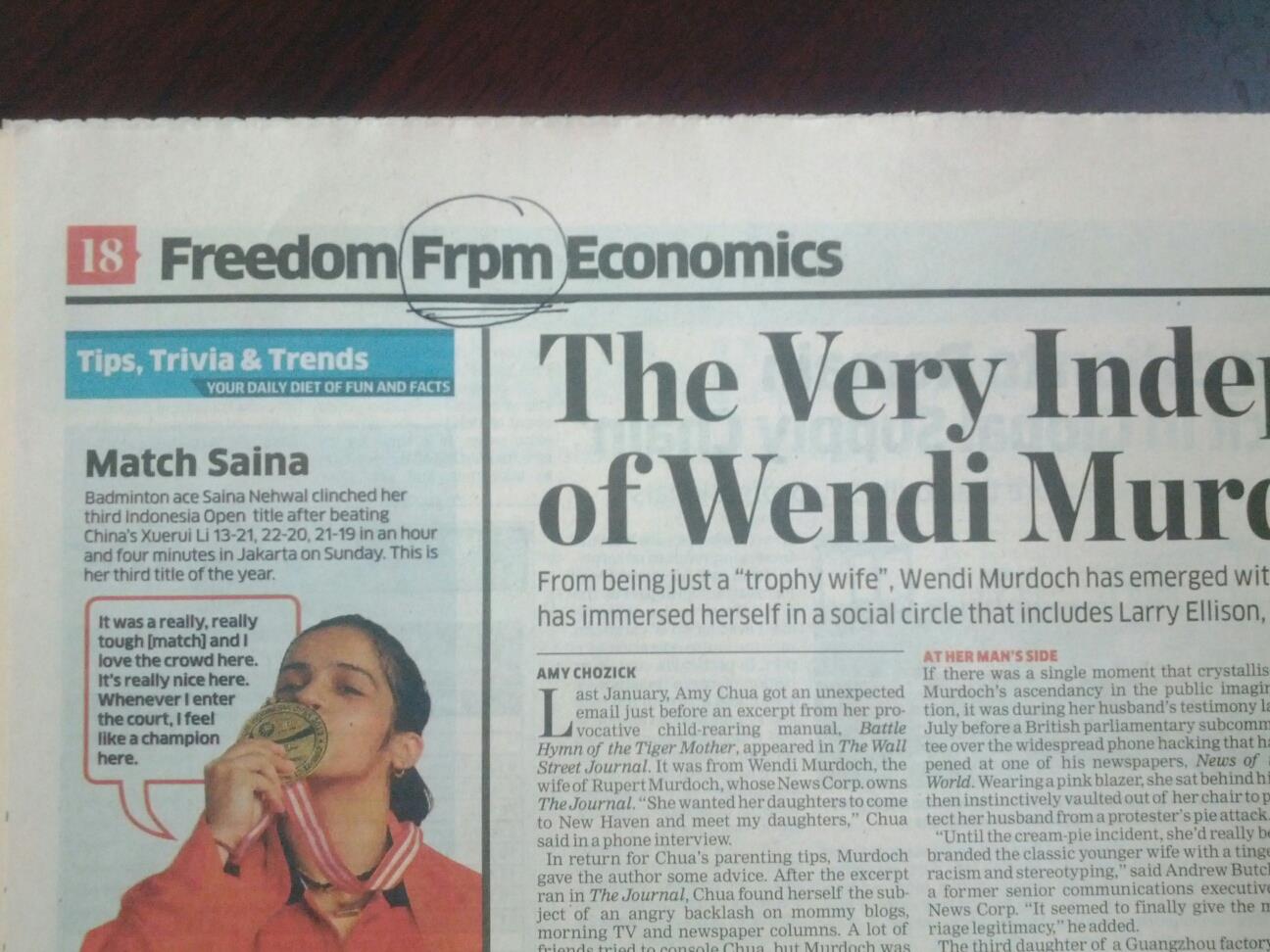
This mornings Economic Times in Mumbai misspells its title on page 18. This is not the only publication that has done it. I regularly see this in a few quality English publications in the country. The reason this is shocking, is having worked in the magazine and newspaper publishing business, I know how important this is to the editor/s. For an editor, the published word is sacrosanct and how it comes through, should be nothing short of perfect.
Even if the data entry operator has made a mistake in typing the correct word, the page proof reader should have picked it up and if not that, the page editor who finally signed off on the page should/could have picked it up, before the page moved for pre-press, pagination and printing. When this chain does not work, there is probably a larger issue at work.
Could it be, that in this fast paced life of ours, we have lost an eye for detail? Or perhaps we no longer care, for such outdated things like “spelling” and “sentence formation”? What with the new twitter, sms and chat cultures, correct spelling and sentence construction has become a lost art.
Perhaps its reflective of the Indian culture and its management practices? In field after field, one can see, we lack the “finishing touch” or the level of “detail orientation” true success requires. We will put up a swashbuckling building, but will not complete the interiors to “global standards”. We will put up a sea link, but not complete the entire design. We will create a new stadium, but leave it unpainted. True success, needs an eye for detail, and the ability to actually complete the job. Its called ‘execution’, all the way till the end.
Because we have all become broadcasters now – we Facebook, Tweet, Blog, give opinions and a lot of us keep jabbering away online – it seems like we talk more about what we do, than actually doing it.
We talk in many subtle ways, about our performances, our glories, our achievements or we become online advisors, giving our solutions, theories and perspectives on things. And while this is satisfying from making our ‘egos feel good’ point of view, often we mix this (both the reader and writer) for actual performance.
I see many writers and consultants in my industry (Communications and Public Relations) and a lot of self-proclaimed opinion makers and opinion gatherers. Most can ramble on, but I only respect the writers and consultants who have some actual performance behind them. Those who have worked deeply and closely with brands, who have delivered on key performance areas while working on these brands and have clients and references that would vouch for their abilities in execution.
Simply talking (online, offline or sideline) is no substitute for the ability to actually execute and deliver results.
Traditionally press conferences have been a useful tool to disseminate strategic information, background information to companies/new companies, present key spokespersons to the media, ensure key messages are clearly communicated or communicate something of urgency and importance. A press conference had many reasons – introducing a new product, revealing a new scientific breakthrough, unveiling a new advertising campaign, announcing a charity event with a celebrity or releasing company financial statements. In the past media loved press conferences, since they gathered information, got an opportunity to meet senior management, interact with brand ambassadors and all in all get an in depth preview into the company, product, launch, strategy, marketing message or key understanding about a company, institution, product or issue. But in today’s environment things have changed. Media may not always have time for a press conference. Or more so, while they may have time for it, they would rather have an exclusive angle, a unique connect with the client, a one-on-one interaction. Unless your topic is of great importance, a national issue where you are making a statement, or you are a celebrity star making a statement, or launching the worlds first sub 1000 dollar car, chances are the media will not make the effort to come to your press conference. Not because they do not want your news; but because they would get your information and news anyways. They are certain, that if they are a media house of importance, the PR agency will approach them with the requisite material anyways. And besides, there are a plethora of information sources today, for the media to not want to move from their chair.

 Dennis Taraporewala